Archive for the ‘Christianity’ Category
Letting Your “No” be a “Yes”
Posted on: February 19, 2015
I got an astounding text from my 23 yo daughter the other day that read, “I think the universe just shifted. I actually like peas now!” To understand the gravity of this announcement, I must go back to her childhood. For most toddlers, peas are a favorite, not only because they apparently taste good, but because they are so easily picked up by that developing pincer grasp. Not Cherry. From the start, peas were a no-go. At our table, our kids were expected to learn to eat what was set before them, even were it only a bite or two. (OK, ok, to be honest, sometimes they were required to eat more than that if it was the main or only course. I hope they have since forgiven me.) But as she grew, Cherry was determined that the little green offenders would find no entrance; many is the time she sat at the dining table contemplating those tiny verdant orbs long after the rest of us had left. The most comical time we remember (and tease her about), was once when she was maybe kindergarten age. We had finished dinner, and to my surprise, Cherry’s plate was clean. “I ate my peas!” she told me. I praised her for it, of course, well pleased that the peas battle had been won with no bloodshed – for that round, at any rate. However, after doing dishes, I went and sat in the recliner in the living room, which has a direct view of the dining table. Glancing over, I noticed something odd under Cherry’s chair – and not just one. On closer examination, I found, you guessed it, a dozen peas! During the meal, she had been surreptitiously dropping those peas one by one under her chair when I wasn’t looking. In the manner of children, it never occurred to her that those peas would stay on the carpet as mute witnesses to her deception. She never pulled that trick again, though she found others, but once she left home for college, you could count on the fact that peas would never soil her plate, let alone cross her palate. When we found Sandra Boynton’s book/CD “Rhinoceros Tap” a few years ago, one song stood out: “O, Lonely Peas”, of which there is a comical performance you can find on YouTube.
One element of Lent is the practice of giving something up – fasting from something – for the Lenten period. I have known many for whom fasting in Lent is a form of self-abasement, a way to remind themselves of what awful, terrible, no-good, very bad people they are. Frankly, I don’t see that in Scripture. Paul identifies himself once as “chief of sinners”, but that is hardly his theme song, nor does he address the believers in the various churches as such. Numerous times we see variations on the Ephesians 5:8 passage, “Once you were darkness, but now you are light.” There’s a then, and there’s a now. Although there is a Lenten element of reflection on how our sin necessitated His sacrifice, I believe the purpose of the practice of Lent and its fasting should not be to focus on US and how far we fall short and what worthless maggots we are, but on HIM, His goodness, His grace to us, the depth of His love for us. In the light of His character and His grace to us, our response is to contemplate the ways in which our “work[ing] out our salvation” needs attention, areas where we are not as conformed to the likeness of His Son as we know we should be, asking His help to “will and to do”.
Rather than self-abasement, the self-denial of the Lenten fast is altogether different. In and of itself, self-denial usually feels like a negative action, but in Lent, that negative becomes a positive. Jesus said of anyone who would follow Him, “… let him deny himself, take up his cross, and follow Me.” If we stop at the denying of self, so that our fasting is only saying “no” to whatever we’ve given up, we’ve missed the point. We fast from one thing in order that we may be freed to embrace something better. Fasting is an opportunity to focus one’s mind and heart on the things of God, beginning with the saying of “no”, but then moving on to a holy “Yes” – the self-reflection of what cross we have yet to take up, and the highest good of what it means to follow HIM.
For many years Cherry would quite willingly have given up peas for Lent, but if the object given up is no real sacrifice, there is no gain from giving it up, either. There are two things that I absolutely love, and that are both rather addictive for me – as in, once I have the first bite, I have trouble stopping: any form of bread or cracker, and sweets, especially chocolate. Because of the way last year went with caring for my mother and cousin being so intense and time-consuming, with all the stress attendant thereto, indulging in sweets and breads almost without limit became a daily practice. So, for my Lenten fast, I have chosen to give up all those things. Yes, even chocolate. It’s not that those things are evil. For me, however, they have assumed too much power; they have become a comfort that only God should be. Saying “no” to these foods is a very real sacrifice, from my mouth’s point of view, but it will enable me to say “yes” to the self-control that is the fruit of the Spirit, allowing God to reveal Himself as the One Who is Enough – not only when it comes to my gluttony, but to other areas of my walk with Him as well.
Last year I gave up iced tea, which I usually drink several glasses of a day. It isn’t a “problem” food, but because of how ever-present that glass of tea would normally be, its absence provided a frequent reminder to pray and seek God’s face. Some people give up Facebook so that they can spend in prayer and contemplation the time they would otherwise spend perusing cute kitten videos, memorable memes, and status updates. Some fast for certain meals and give the money saved to a compassionate cause, asking God to teach them His love for others. The possibilities are endless, but if you choose to fast for Lent, remember that it is not enough to just say “no” – go on to saying “Yes!”
Peas be with you!
Ash Wednesday 2015
Posted on: February 18, 2015
I love organizing. It’s one of my most useful vices. Normally through the course of the year I go through just about every cabinet and shelf and closet to sort out things that no longer need to be kept, and to optimize the organization of what is left. Last year being what it was, I didn’t get to do that, so since the start of January, I have been immersing myself in catching up on it. Several boxes have gone to Goodwill already. It gives me a sense of security and freedom to know just what I have and where it is, and to feel reasonably sure that I am not allowing my house to build up a weight of unnecessary belongings.
For most of the world, yesterday was a big day. Mardi Gras is one of the biggest parties of the year, an excuse for drunkenness, lewdness, and revelry – a celebration of debauchery. I doubt that the majority of the celebrants even know what Mardi Gras means. As far as the world goes, hey, any excuse for a party, right? As for Lent itself, the world, if it has any knowledge of it at all, sees it only as the spoilsport of Mardi Gras . Even among Christians, there are a lot of erroneous ideas about what Lent is, associating it only with having to “give something up” for Lent. In reality, Lent is a positive, deeply meaningful season.
From the early centuries of the Church, a traditional calendar grew up that marked certain milestones in the life of Christ and of His Church, not unlike the Jewish festivals which likewise follow the seasons and serve as reminders of important events in the Old Testament. Most Protestant churches have abandoned that liturgical calendar, which is a shame, for, just as the Jewish people would through the year relive key moments of their history, so, too, does the liturgical calendar call Christians to reflect on key moments in ours. The calendar begins with the season of Advent, a time of preparation for Christmas, calling for reflection on why Christ came and focusing on the foretelling of His birth and earthly life. Next comes the twelve days of Christmas, celebrating His birth. January 6th marks Epiphany, remembering the coming of the Magi. The season of Epiphany lasts until Lent, and the focus during this time is the life and ministry of our Lord, with the study of the Gospels. Lent is a time of preparation for Easter, and the Easter season itself lasts until Pentecost, when we celebrate the coming of the Holy Spirit. From Pentecost until the final Sunday before Advent, the focus is on the Church and the non-Gospel books of the New Testament. The final Sunday before Advent is known as Christ the King Sunday, a celebration of Jesus’ second and final coming when He shall reign forever. While none of these seasons and celebrations are, of course, dictated by Scripture, their observance gives a beautiful rhythm to the year. As put by Archbishop J. Peter Sartrain, “The liturgical year continuously exposes us to every aspect of the mystery of Christ – not because we best understand His life, death, and resurrection in chronological order, but because by being continuously exposed to Christ, we allow Him to enter more deeply into our lives. The same lesson I learn this year can be deepened next year, both because I have had new experiences and because I have allowed Christ to help me understand them in His light.”
Last week a friend gave me two little devotion booklets for Lent. One of the booklets begins with the prayer used by the Roman Catholic Church for the first Sunday in Lent which I think is going to serve as a thoughtful starting place for me this season. “Grant, almighty God, through the yearly observance of holy Lent, that we may grow in understanding of the riches hidden in Christ and by worthy conduct pursue their effects.” For some, Lent is a season of focusing on their own sinfulness and unworthiness, and fasting from some certain food or activity is simply a form of self-mortification to emphasize the point. How very different an approach, then, to consider Lent not a time to look inward only, but as a time to immerse oneself in focusing on growing in understanding, not of ourselves and how horrible we are, but of HIM, and how great He is. From that starting place, we then consider our lives and how we are living them. It is a time of doing to my life what I am doing to my house: facing up to what’s there and deciding if it’s something I should keep or get rid of, or if there’s a better way I should be handling it.
We all have things in our lives that we need to get rid of or change; we all need to “clean house.” Let this Lenten season be our opportunity for asking our Father to shine His light into the all the corners, and then asking Him to help sort out what we need to get rid of.
Limited Time Offer
Posted on: July 7, 2014
One of the most enjoyable courses I ever did in homeschooling was in critical thinking. We used a book from Critical Thinking Press (marvelous source for all kinds of thinking-related materials.) The book first had a short course in logic (e.g. The statement “All dogs are mammals, and all mammals are animals, therefore all dogs are animals” is true, but the statement “All dogs are mammals and all cats are mammals therefore all dogs are cats” is NOT true.) The book then presented various blind spots, mind traps, and slick tricks that people use and/or fall prey to, dissecting each of them carefully by applying the principles discussed in the first part. Political speech and advertising, not surprisingly, provided that vast majority of fodder for the analysis.
One very successful sales ploy is the “limited time/amount” sale. The “Call now! Operators are standing by! This offer good until only midnight tonight!” TV ads. The “lowest price of the season” ads in the newspaper. (Ever notice just how many “seasons” some stores have??) The “Only 5,000 of these minted! Don’t miss out!” commemorative coin. The “I can only offer you this price today because the boss is on vacation” car deal. Marketers know that there is something deep in our psyche that reacts to the idea that there won’t be enough of something to go around.
The weeks since my last post have been the calmest I’ve had since Thanksgiving, with only one or two minor unexpected things cropping up, and a few major issues resolved. Although I know these days have had the precise number of minutes in them as any of the days preceding them, they’ve felt hours longer. I’ve gotten so much done! Last Thursday, I actually got my sewing machine out for the first time since mid-November. I had only just started a set of curtains before Thanksgiving was upon us, so I hastily got them done enough that I could at least hang them from the rod so our guests would have something nicer than an old sheet over the window. With Mama’s cancer diagnosis coming right after Thanksgiving, and all that has been since, I hadn’t touched those curtains again. I’ve now gotten them done, and not only the curtains, but two covers for throw pillows on the couch. Hurray!!!
Why didn’t I get them done before now? I just didn’t have the time. No time. No time. That’s been my mantra for the last 7 months: I don’t have time. I don’t have time. “No time” became a reason – or an excuse – for not doing all kinds of things. Exercise? No time. Eat right? No time. Keep in touch with friends? No time. Work on projects? No time.
I’m not denying that things have been quite hectic – they have been – but two things recently have helped me realize that it was my perception of how busy things were that had more to do with the problem that the actuality of what was going on.
The first thing was that I read an interesting article in Readers Digest a month ago about insights from a book called “Scarcity: Why Having Too Little Means So Much” (by Shafir and Mullainathan). The book’s authors are social scientists who have studied people in the context of a variety of contexts of scarcity – people who are financially poor, people who are extraordinarily busy, people who are dieting, people who lack social companionship – and what they have found is quite interesting. To quote the RD article,
“…whenever we perceive a lack of something – be it food, money, or… time – we become so absorbed by it that our thinking is altered. … ‘Scarcity captures the mind.’ the authors write. ‘The mind orients automatically, powerfully, toward unfulfilled needs.’ … in all kinds of circumstances, the psychological effect of scarcity was remarkably similar: a kind of tunnel vision that can help us focus on the immediate need … but that can also have negative long- term consequences, both in terms of ignoring other important areas of our lives and not making good decisions for the future. …. Fluid intelligence, cognitive capacity, and executive control all come under what Shafir and Mullainathan term mental ‘bandwidth,’ and even the slightest suggestion of scarcity taxes our ability to reason properly, control our impulses, and think clearly.” [emphasis added]
So, for example, the chronically poor may be great at squeezing 6 nickels out of a quarter, but they tend to be poor at making decisions that will lead to longer-term financial stability. People who are dieting may become so focused on what they are eating – or rather, on what they are NOT eating – that they can’t focus on their work. Looking back, not only on these last 7 months, but on other hectic times in my life, I can clearly see scarcity-mindset-induced tunnel vision, poor impulse control, and brain fog in my own life. Faced with a belief in the scarcity of some resource, we all fall prey to the same kinds of effects.
The other thing that happened that jolted my thinking about how much time I have was a conversation with my younger son. When he dies, his epitaph should be, “I was reading this article the other day….” You see, he is ALWAYS reading. He pulls up the most interesting facts and theories from all kinds of sources about all kinds of subjects. What amazes me is where he finds the time to fit it in! You see, at the time of the conversation I refer to, he was spending time every day working out to keep in top physical shape, as is expected for a physical trainer. And taking a class in Muy Thai kickboxing. And one in jujitsu. And learning how to kite board. He had a standing pool game night with friends once a week. Played in an ultimate Frisbee league every week. Went for frequent hikes with friends. Was working part-time 20 to 30 hours a week. And, oh, yeah, did I mention he was in his last quarter of his senior year getting his bachelor’s degree in kinesiology? I asked him if he actually did things like, you know, sleep. Eat. Relax. He responded, “Mom, there are 168 hours in every week. Even getting the 8 hours of sleep a night that I do still leaves 112. My various classes and work and hanging out take about 80 hours a week, which still leaves around 30 hours for other things. Besides, reading is as ‘relaxed’ as I get. My brain’s always moving!”
Hmmm…..
I have those same 168 hours in MY week. I added up how I typically use them and frankly, it’s too embarrassing to share! I wasted more time than I want to admit watching TV or catching up on facebook, or doing things that, while more-or-less useful didn’t advance the causes that really needed advancing. There’s a considerable amount of time that I simply can’t account for. I am not the ADHD Energizer bunny that my son is, so it’s not that I would expect to rival his level of activity, but I can see now that even in the busiest of my weeks, I actually HAD time that I could have used to get things that mattered done.
Instead, I had tunnel-vision, getting hung up on the idea of needing large blocks of time to do things, rather than breaking projects down into their component tasks that would take smaller blocks. Those curtains? It took four hours total to finish them. That’s only 8 half-hour sessions, or 12 of 20 minutes, or even 24 of just 10. There’s no way I couldn’t have found that much time in the last 7 months. Ditto with finishing the pillow covers or any of the other many sewing projects languishing on my sewing table, or the many computer projects waiting to be done, or who knows what all else! (Writing blog posts, unfortunately, isn’t something I can do in snatches. It would be like trying to swim laps in a wading pool!)
Going back to the “poor decision-making” aspect of the scarcity mindset, I can see how many times I did something that “saved” time for the short-term that actually COST time in the long run. For example, if I put something down “for now” where it doesn’t belong, I may forget where I put it, resulting in time spent looking for it, or the object will gather friends around it, resulting in taking a much longer time to put everything away than it would have taken to put them each away properly in the first place. Oftentimes I didn’t take time to plan things out thoroughly, resulting in backtracking, undoing, redoing, leaving things undone, and so on. Taking the time to plan things in the right order would have cost time in the short run, but saved time in the long run.
All this has gotten me thinking about how we fall into the same scarcity trap spiritually. When we worry about running out of any earthly resource, what we’re really worrying about is whether we are going to run out of God as well! We start acting as if we were on our own, having to fend for ourselves. We get the same tunnel vision, unable to see anything but our fear. We have the same poor impulse control, jumping at anything that looks like a solution. We lose our ability to reason, our minds “hamster wheeling” round and round on “what ifs.”
God promised that HE will always be sufficient. Always. If we don’t have time to do all that we need to do, HE will be sufficient to deal with the consequences of anything left undone. If we don’t have money enough to pay our bills, HE will be sufficient to help us deal with the consequences. If we never meet that “Mr./Miss Right”, then HE will be sufficient to help us live a life as full as the single life He lived. Whatever our shortage, His grace is sufficient. His strength is sufficient. His power is sufficient. HE is what we need, nothing less, nothing more. There’s no such thing as scarcity when it comes to God. He has never run out, and never will. If we focus on how much there is to have of Him, we’ll lose our fear of not having enough of anything else.
His is the Best Ever exclusive, limited time offer. It’s only good for His children, and only good for Eternity. Don’t wait! Call now!
Finally getting a chance to finish up telling you about our Christmas. And this time, I have pictures!
If Christmas Eve was “O, Holy Night”, Christmas Day was definitely “God Rest Ye Merry, Gentlemen”! This will definitely go down in our family history as one of the most zany and outrageously funny ones we have EVER had.
For a number of years now, our family has been trying to do things other than the traditional gift thing. Partly this arose from the fact that with this big a family, it gets awfully expensive, not to mention difficult, for everyone to get everyone something. Besides, and more importantly, buying stuff just for the sake of buying stuff – even to say “I love you” – when we already have MORE than enough stuff, seems pointless. So, for a few years, the kids did a round-robin exchange. Then they had each person do a donation in the giftee’s name and give the giftee some little something connected with that organization. Last year, we all pooled of our Christmas gift money and sent one big donation to an organization my brother is involved with. This year, Bethy suggested we do our own things about donations, and do a round-robin exchange of “I would if I could” gifts. That is, “If neither time, money, nor physics were an object, I would give you …..” A new car? A bigger house? A vacation in France? A trip to the moon? All the tea in China? The only limit would be our imaginations. If desired, you could also give a real gift related to the imaginary one, but the important thing was the imaginary one.
For some of us, it was an invitation. As Brooke put it when I announced that I would be texting each person with the name of their intended victim, er, recipient, “Let the shenanigans begin!” For a few, there was at first a “Huh? What on earth am I gonna give X?!?” reaction, but blank stares were quickly replaced by gleams in the eye, mischievous grins, and “Oh, boy, this is gonna be GOOD!” Those of us who knew something of what others were doing pitched in with extra ideas, helping to hone the projects to perfection. The results couldn’t have been more worth it!
Phil gave Bethy her dream house – big house, nice front porch, huge yard with gardens. All she has to do is assemble the 300 pieces of the jigsaw! Jillian gave Brooke a house, too, specifying a number of rooms, such as one JUST for her sewing, complete with a fashion runway. (Brooke is a fashion design grad.) It also came with a huge kitchen for her to play in and all kinds of equipment for cake decorating – starting with the set included in the package.
Bethy gave me three letters. The first is dated 12/20/2014, from writing agent Walter Wordsmith, telling me how blown away he was by the manuscript my daughter submitted for me of my first book, Raising Five Kids with Five Brain Cells, congratulating me for being on the New York Times best-seller list for 15 weeks, and suggesting two more books. The second letter, 2/21/2015, from Spurilious Publishers editor Douglas Inktopolous, confirms the contract for the second and third books, and says he hopes to see the draft for the second – Where Are My Kids and Who Are These Teenagers? – by Christmas. The third letter is from film director Frank Philographer letting me know how the filming of the story based on my third bestseller, Rockin’ & Rollin’ On the Front Porch Swing, is going. I get a cameo appearance, of course, and “(after reviewing the 217 photos your husband submitted) the casting call for child actors for that scene was quietly dropped since your actual grandchildren are clearly cuter.”
To Darien, the fitness buff getting a degree in kinesiology so he can be a personal trainer, Brooke gave the gym of his dreams, and suggested services such as a wind tunnel for sky-diving training, indoor rapids racing, a 5 story climbing wall, shark tank swimming lessons, rabid wolverine wrestling, Temple of Doom Endurance obstacle course, and King David’s Mighty Men certification. Bonus gift: 5 year exclusive contract with Brooke’s imaginary clothing company to produce all his “gym swag needs.” Along with this certificate came the T-shirt Brooke made, as seen in the photo.
Cherry gave her dad some coffees from around the world, and a note that said, “If money were no object, I would pay for you to spend a year travelling the world, taking pictures and tasting exotic coffee.” The funny part, though, was that the first time she printed the note up, she used a fancy font that looked very dignified an official-like….. Reading it, however, she realized that the “x” looked almost identical to the “r”, which gave “exotic” a rather unfortunate appearance!
My brother, Tim, a physics prof at Azusa Pacific, was up from SoCal to see our mom. He is a wonderful guy, witty, thoughtful, tender-hearted….. and as disorganized as you will ever find. He is chronically behind on grading tests and papers, his office shelves look like an office supply store exploded, and I don’t know if he even remembers what color the carpet is under all the files, books, and other detritus thereon. So, we gave him a new app – the “iDO”. When he needs something done, he just has to say, “Who wants to …?” and “iDO!” Jillian designed the button for it with many helpful suggestions for the app to do, such as “schnorfle the snickerbokers” and “unfrazzle my frumpkis”. 
Jillian is a major Dr. Who fan. (If you’re not, you probably won’t get this.) So I gave her a little computer monitor bobblehead of the Tardis, a DVD of the 50th anniversary episode, and a note with a picture of David Tennant (her favorite doctor) that said, “Come fly with me! You have been chosen as the Doctor’s new companion to defeat the Daleks, outwit the weeping angels, and have many adventures with that wibbly wobbly timey wimey…. Oh, you’re back already! Hope you had a good time!” 
To nephew, John, who is part of a medieval knights re-enactment troupe, went participation in a full re-enactment of Henry V’s Battle of Agincourt –with a little set of knights and castles Legos to practice with. Tim’s wife, Beth, whose daughter and family moved to Oklahoma this year, bringing on an acute case of grandchild-withdrawal-syndrome, got a Star Trek transporter.
Darien gave Nathan a huge workshop in which to create interesting and/or destructive electronic toys. So what’s with the slice of pickle, you ask? That’s a loooooooong-standing family joke. When I was in high school, my brother Corey gave me a bookbark that was all green and on the top corner looked like it had a bite taken out of it. The bookmark read, “This isn’t a bookmark. It’s a flat pickle.” So, every Christmas, at various times, someone will make a joke about some package being a flat pickle. Darien just figured it was about time someone DID get a flat pickle! 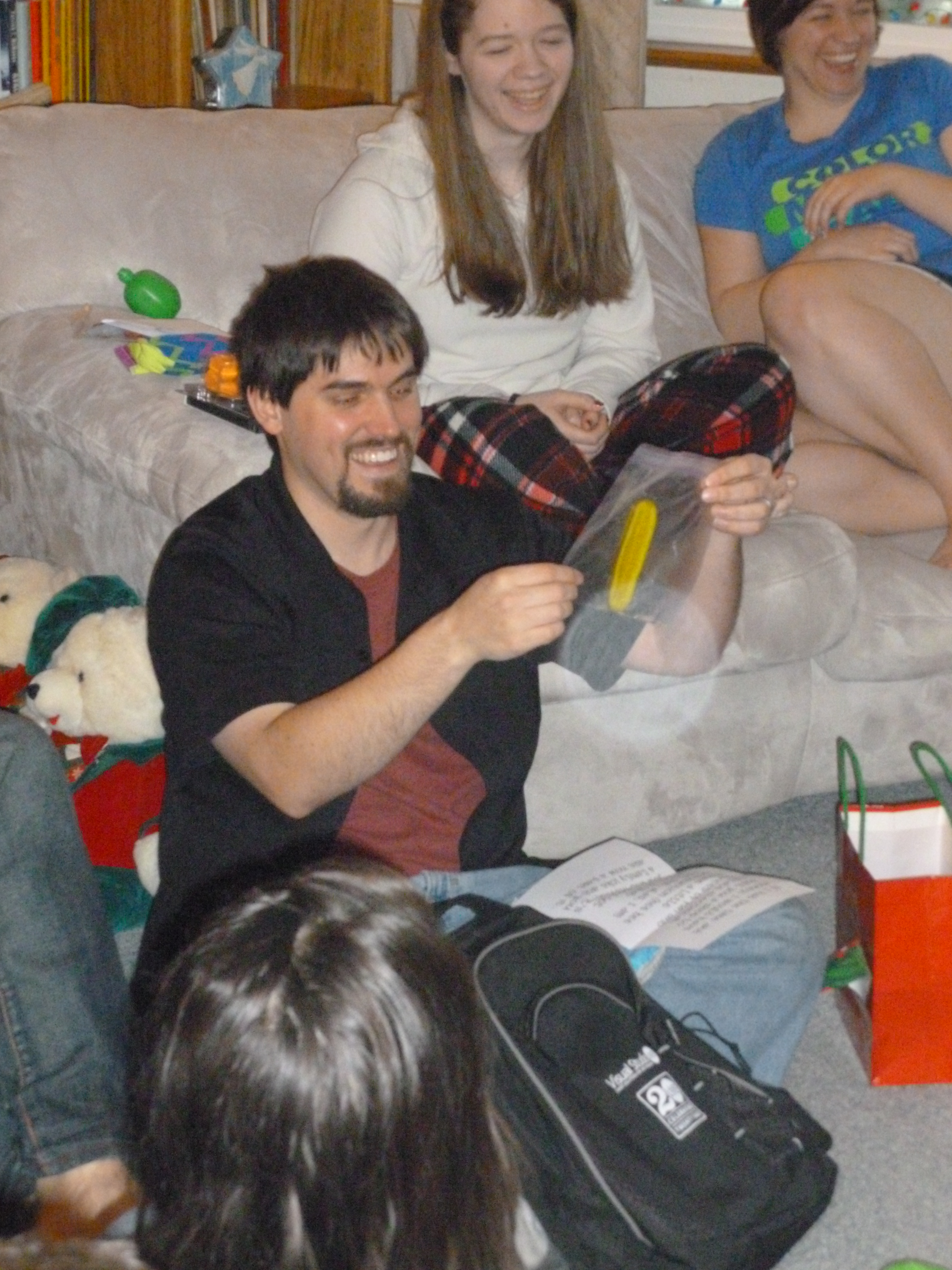
The two most elaborate gifts were put together by the two family members who I think any of us least expected it from. Nathan gave Cherry a trip around the world. That is, he wrote out THREE PAGES of an itinerary. It detailed where she’d go. It detailed how she’d travel – for instance, by elephant from Thailand to Australia. It detailed the kinds of things she would buy where, and came complete with homing drones to carry all of her purchases home so she wouldn’t have to worry about shipping. The description was filled with bits such as “Run out of money? Just print more. (Hey, it works for the government!)” In the very first paragraph, she was instructed to bring with her a bag of marshmellows, and throughout the trip, there would be a reminder about that bag of marshmellows. At the end, she finds out that that day is the pilot’s birthday, and, luckily, she has a birthday present on hand for him: a bag of marshmellows!
To Phil, Rob gave a Seahawks Superbowl package for him and three friends. (Yes, they ARE going to the Sueprbowl. The Seahawks, that is, not Phil and friends.) The package included flying to New York in Paul Allen’s private jet; staying in the same hotel as the team; having a team Visa card to use for all expenses; being in on all the practices, film reviews, coaching meetings, etc.; being in the locker room before the game and running out the tunnel with the team, carrying the 12th man flag; getting to sit in … all the various places in the stadium where they have coaches and spotters and whatever, as well as in the VIP booth. And when the guys return home, Phil will be greeted by Brooke and the girls who will just have gotten home from a trip to any spa of their choosing in the world! This was all detailed in about FOUR pages of description, complete with photos of all the relevant people named. And it came with a Seahawks lanyard to carry his VIP pass on. 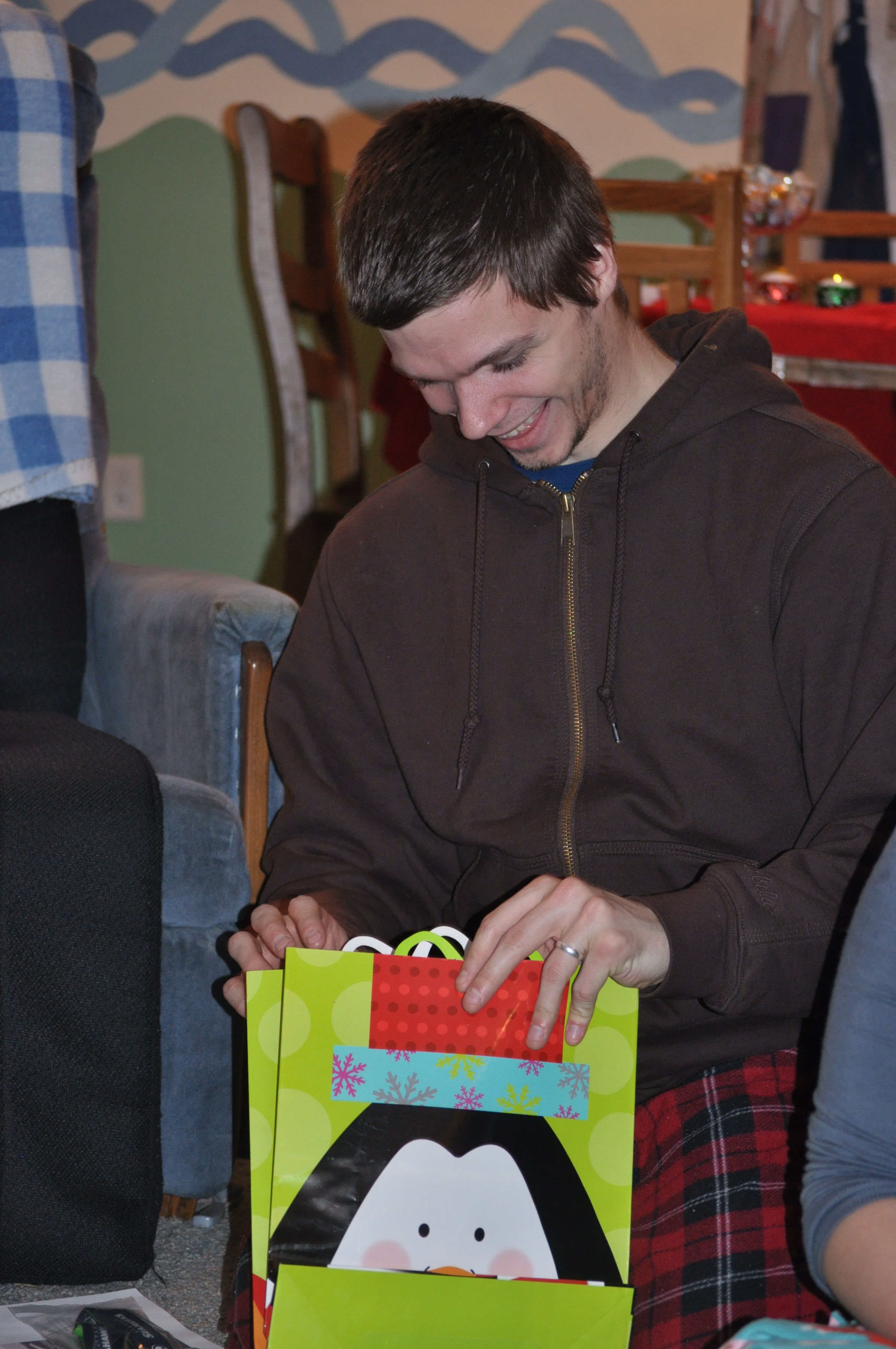
Yep, this Christmas is going to be awfully HARD to top!!
When I think of Christmases growing up, I think of a lot of FUN. And quite often, my mom was at the bottom of it. She always found the coolest, funniest, most intriguing little things to put in our stockings. There was the Christmas of The Wind-Up Cars. She found these tiny little funny wind-up cars that went Zip!, and we each got one in our stocking. I’m not sure who started it, but that whole holiday, I remember that every meal was accompanied by cars zipping across the table hither and yon, crashing into glasses and plates or launching off the edge. Her creativity in wrapping was amazing; every package was a work of art. I remember one package like a scene around a little silvery foil lake, with cotton snow, cut-out pine trees, and paper-clip ice-skates for the skaters. Mama loved secrets, and hiding things, and the fun of the discovery – though she did occasionally hide things too well. Until maybe my teens, there seemed to be a tradition that she always forgot one of my presents somewhere. One of my siblings would ask what I thought of my new thus-and-so, I’d looked puzzled, and they’d holler, “Mama! You forgot the –!” And Mama would stand trying to think just where she’d put that…. She always did remember. Sooner or later.
I could go on for pages with funny memories from those Christmases long past, but I won’t. The point is that Mama and Christmas fun are entwined in my memories of childhood, so how incomparably fitting it is that this, the last Christmas where she will be present, should have so much fun in it?
Now to start working on ideas to do for NEXT Christmas! Mama won’t be there – but her spirit of fun and legacy of laughter sure will!
Behind or in front?
Posted on: January 17, 2013
The name of my blog is taken from a quote that gives the chemists’ definition of a “solution” – something that’s still all mixed up. Looking at most of my posts, I don’t sound very mixed up. I tend to speak with a high degree of self-assurance, but I would like to make clear that while I do tend to speak in rather definitive tones, I don’t ever mean to imply that I have all the answers. I am fully convinced that equally intelligent people of equally good will may hold very different viewpoints. Today’s post is one that goes back to my “mixed up-ness”, for it speaks to an issue about which I have very mixed feelings – but on which many hold very, VERY decided opinions. So, take these musings in their proper context, please!
* * * * * * * *
I live in an area that has within about an hour-and-a-half’s drive an army base, air force base, and naval base, with tens of thousands of troops stationed at each. There are multiple National Guard units. There are several seaports, so we are a jumping off place for thousands of tons of military equipment being deployed to/returned from overseas. On any highway, or in any apartment unit or store parking lot you are likely to see license plates from any corner of the country – Maine to California, Florida to Alaska, and, yes, even Hawaii. In any school classroom, there are likely to be a few kids whose dads are either just leaving, in the middle of, or soon to return from a multi-month deployment. The military complex drives a huge part of the Puget Sound economy. Uniforms and buzz cuts are as familiar as Birkenstocks and umbrellas.
It’s not surprising, then, that bumper stickers and Facebook posts here carry lots of pro-military slogans. The two most common are these: “If you won’t stand behind our troops, feel free to stand in front of them” and the milder “Support our troops”. The first one really bothers me. Whether you read it as “if you don’t agree with my definition of supporting our troops, you are the enemy” or as “if you don’t agree, you should be shot”, the sentiment runs counter to the very idea of freedom our troops are supposedly fighting to protect. If we aren’t free to disagree, we’re not free at all! The second phrase carries no condemnation with it, but while I understand the intent, I still find myself wondering just what exactly does it MEAN to “support” our troops?
This isn’t just a matter of theoretical interest to me. I have four “othersons”, boys I’ve known since their childhood or infancy, who are or have been in the military, two of whom have done one or more deployments in this “war on terror.” (I’ve met with their mothers every Tuesday morning for prayer and Bible study for 23 years.) I know several other friends of my kids who are also in the military. I’ve known any number of military families in the churches I’ve been in for the last 28 years. This question of supporting our troops matters very personally. This question has faces. Yet surely, supporting our troops must include a certain degree of … friendly skepticism, if you will.
Not everyone wearing a uniform deserves to be put on a pedestal. No matter how much patriotic sentiment likes to paint a portrait of all soldiers as noble, self-sacrificing heroes, the truth is that soldiers are people, and as such, they run the same gamut as the rest of the population. Read the news around any military-thick area and there will be stories of drunken fights, underage girls smuggled on base with fake IDs for sex and drug parties, domestic violence, drug rings, theft rings, gangs. Some soldiers are using their service to serve themselves, not their country. What does “support our troops” mean in this context?
I am awaiting a chance to read a new book that’s just come out called One Step Ahead of the Devil by L.M. Hausen. (Available at Amazon.)It’s not going to be a fun read. I already know the basic story because I was privileged to be in one of the groups praying for the family as they lived through the events described, the story of a military doctor who refused to falsify some records. The retribution meted out is a harrowing tale that you’d expect from communist Russia, not America. (In case you’re wondering, the story was verified and reported by Sam Donaldson on ABC News. It is fact, not conspiracy fiction.) We’ve all read of other abuses of power by military officers, of sex scandals, of deaths by hazing. The statistics on the rape and sexual harassment of female troops deployed in Iraq and Afghanistan are shocking. What does “support our troops” mean in these situations?
What does “support our troops” mean when faced with events such as the Abu Ghraib prison debacle, or the more recent civilian massacre? What does it mean when one sees photos of American troops posing in apparent glee over the bodies of the dead enemy – bad enough in itself, but all the worse for the extra rage it will engender in the survivors, rallying more to their cause, and in the end, resulting in the death of even more American soldiers?
What does “support our troops” mean if one fervently believes that what they are doing is politically, militarily, and sometimes even morally, wrong, that our troops have been sent to a place they should never have been sent to, to do a job that they should never have been given, for a reason that could never be justified?
I believe the majority of military personnel, like the majority of the civilian population, are basically decent, hard-working people, doing a job that is incredibly hard and that the rest of us wouldn’t do unless compelled by a draft to do so. They are forced to make decisions the like of which I can scarcely even begin to imagine, in conditions that make me shudder to think of – but I recognize that not all deserve the “hero” label. I do not hold the individual soldier responsible for where he finds himself stationed or the war she is assigned to fight – but I do hold them responsible for recognizing the moral limits of the authority of those over them, and for conducting themselves in a manner befitting the uniform they wear. I believe that even if one is utterly convinced that a particular military campaign is wrong, it is never right to take that anger out on the soldier passing by on the street – but I do not believe it is wrong to make one’s voice heard to the leadership of the country in an attempt to get our troops out of it. I believe it is a shame that our country pays many of its soldiers so little that their families qualify for food stamps and other assistance even as the soldier is putting his/her life on the line, and it is an outrage that our country, having exacted so much of our soldiers, provides such poor care after they have served, especially when they have sacrificed bodies, sanity, and family in that service – and there are no “buts” about this one!
I do pray for our troops. I pray that they would conduct themselves with honor and integrity, with wisdom and discretion, with compassion and mercy. I pray that they would not dehumanize either themselves or the “enemy”, but would value all life and not take it from another lightly. Even recognizing that not all civilians would necessarily understand the reasons for their actions, I do pray our troops would take no actions which they would be ashamed to confess before God or man, or which will haunt them after they are home. I pray for their safety. I pray for wisdom for our leaders, that they would not use our soldiers as mere political pawns. Although I personally have a hard time reconciling Christian faith with military service and the taking of life, I pray for the success and advancement of those who can do so, so that they may influence those around them by a Godly witness.
This – prayer – I believe is the responsibility of every Christian, no matter what they may feel about the military or its actions. I believe we are just as responsible to pray for the innocents caught in the crossfire, and even for those who seek to destroy us, if we would follow Jesus’ command. All are ones for whom our Lord gave His life and desires to see come to repentance and salvation.
Just what DOES it mean to “support our troops”? Equally sincere people may reach very different conclusions about it – and though I’m sincere, I haven’t reached a conclusion yet, other than this: it is safer for a society to have a healthy “loyal opposition”, than to have unanimity by silencing all dissenting voices.
If that doesn’t suit your definition of “standing behind our troops”, then prepare the blindfold. I’m ready for the firing squad!
First, for the nitpickers, yes, I know that’s not quite a direct quote. Poetic license.
I have an extreme dislike of the unscriptural term “prayer warrior”. Unscriptural? Yep. Although there are some who are recorded as “wrestling in prayer” for others (see Epaphras), nowhere does the Bible distinguish some believers as “better” pray-ers than others. Certainly there were instances of someone who was willing to “stand in the breach” on behalf of others, but it was that person’s willingness to intercede, not some special ability to do so, that garnered God’s favor. Look at the lists of specific, special spiritual gifts and guess what you won’t find? Prayer. Soldiers fight wars; civilians don’t. If the Church has “prayer warriors”, then an impression may be given that prayer is something that should be left to the “professionals”. Non-“warriors” get the idea that “warriors” are somehow more “effective” pray-ers. Both ideas are mistaken. There are no prayer elites; ALL believers are commanded to pray. Just as there are those who have a great passion for study, for missions, for caring for the poor, for working with children, there are some within the Church who have a greater PASSION for prayer than others – but that does not make them a class apart, let alone somehow “above” the rest.
Given that every believer should pray, I decided I would share how I keep track of who and what I pray for. (This isn’t about my personal prayer – my own confession, praise, supplication, or time spent listening – though all are key parts of a believer’s prayer life. For these, I don’t have a schedule, and I don’t follow a formula. Those are meaningful to many, but I don’t happen to use them. Yea, freedom!) Although I do a lot of on-the-spot prayer for and with others, I floundered for years trying to figure out a way to be more consistent about praying for the people who are a more or less permanent part of my life. I finally ran across some descriptions by other folks that inspired me some years ago, and over time those suggestions jelled into my current practice. I don’t necessarily get this routine done every day. Weekends, and Sunday especially, I’m most likely to not get it done, since Saturday I’m totally out of my weekday routine, and Sunday I’m getting ready for church. Some days I blitz through, and some days I spend a half hour. I’m not as consistent as I’d like to be, but doing it this way at least keeps me MORE consistent than I otherwise would be. This is not intended as a “how to” for everyone – it’s just a “how I” that might give you ideas as others did for me.
I have a small 3-ring binder to keep my prayer stuff in, with three sections. The first has a month by month calendar in which I’ve noted birthdays and anniversaries, and to which I add things such as surgery dates, test dates or graduation dates for students I know, travel dates for mission trips – anything with a specific time frame.
Stuck in the current month, and moved along through the year, is a card with lists of people for whom I pray every time. I list moms-to-be and their due month, with baby’s name if known; these may be family or friends, or increasingly common, children of my friends as we all enter the enchanting land of grandparenthood; I pray that God would knit those babies safely in their mothers’ wombs and keep the mom in good health as she carries her precious burden. (If there are specific concerns, I mention those, too.) Having lost my own father 21 years ago when I was only 30, I have a heart for those who have lost parents, so there is a list of folks who have lost their parents within the last year, which parent, and the month of the loss; I pray that God would comfort them in any stray moments of grief that hit or any anniversaries of events such as birthdays or wedding anniversaries. We have several friends who have children who have turned from the Lord completely, and our own son who, while he has not turned from the Lord, is not living by His standards, either; these are all brought up with a prayer that He would draw them back to Himself, and give the parents wisdom on how to love them with God’s fatherheart. There is a list of soldiers deployed to dangerous places, for whom I pray safety, and that they would take no action for which they would feel shame confessing before God or man; and I pray for their wives and children, that they would be provided for and protected. I pray for our nephew, who is currently a missionary in Africa, that he would be kept safe and that his work would be fruitful. Finally, I have a list of specific family and friends who either don’t know the Lord or who have walked away from childhood training in Him; for these I pray that God would send folks into their path that would speak His word to them, that He would give us wisdom on what/if to say ourselves, and that He would bring them to know Him. Notice that none of these take more than a few sentences each. God listens to our heart, not the word count.
The next section to come up is my immediate family. I pray daily for my husband. I’ve used prayers modeled out of Stormy Omartian’s book The Power of a Praying Wife and others, but I focus a lot on his work, since he labors in a spiritually and emotionally toxic environment. After Rob, is the kids’ section. For them, as for the next section, each has his/her own page, with general and specific prayer items underneath. Since we have five kids, and there are conveniently five days in the week, each kid gets his/her own day for me to focus on in prayer. (If that child has a family now, then I do the whole family on that day.) Some years ago, I chose a theme verse for each of the kids/families, and have it written at the top of their page, so I first pray that verse over them. Then I pray the general things. For all the kids, I pray for their relationship with the Lord. For married kids, I pray such things as for the husbands to cherish the wives, for the wives to trust the husbands’ leading, for the wives to be good managers of their homes, for the husbands to find favor with their employers. I pray for wisdom for their parenting. I pray for my grandkids to grow in grace and the knowledge of the Truth. For my unmarried girls, I pray that if it is God’s intent that they should marry, that they would keep themselves in purity and that they would be preparing themselves to be fitting helpers for their husbands, and (as we have prayed for all the kids since they were little and have seen come to fruition with our oldest two) that God would likewise be preparing their future spouses. Then there are prayers for specific things such as jobs needed, school, housing, illness and such. Answers are noted, too, both here and in the next section.
The final section is by far the longest. It is similar to the kids’, except that it doesn’t have a verse for each one. In this section, I have a page for each extended family member/whole family (mom, siblings and siblings-in-love, aunts, uncles, cousins), close friends and their children, and my “otherkids” who I have known from infancy or toddlerhood here and am very close to. I also have some pages with lists of names that I don’t do as extensive prayers for, such as old homeschool friends who I am in little contact with now but who I still think of fondly or all the pastors I know. The key to doing this section is that I do not pray through all these pages every time, but just for a few, moving a marker along. Some days I may pray one or two pages, sometimes four or five, depending on time and how the Spirit moves. Sometimes someone is on my heart “out of turn”, or there are other things on my heart and I don’t get to that section at all. It generally takes me a couple of weeks to go all the way through the section – but at least no one gets forgotten!
There is no one “right” way to conduct our prayer life, no one “right” cause to pray for. I have a friend whose passion comes from the injunction to pray for government leaders. She begins every school day with a folder containing the names of every elected official for our county, for every state and federal legislator, for judges, for Cabinet members, and the President. She prays for them each by name. There are those whose passion is for missions, so they pray for many missionaries and mission organizations and for specific countries. There are those whose passion is the unborn, so they pray for the unborn, for their mothers, for agencies reaching out to them, for the holding back of agencies working against them, for government policy makers. And there are many, many Christians who don’t feel a particular burden for ANY special group, need, or cause! If you’ve asked God to lay something on your heart, and He hasn’t, then don’t worry. He obviously isn’t calling you to prayer as a passion, but has some other ministry for you to focus on.
Whether we have a passion for prayer, or a particular passion for which we pray, we are all TO pray; it is not optional. Like any spiritual discipline, the more we pray, the more familiar doing it becomes. If we ask God to teach us to pray, as Jesus’ disciples did, He will surely do so.
Prayer isn’t a matter of being a “warrior”. It is a matter of being aligned with God’s heart – and that is something open to ANY of His children.
 the susie solution